Inside the FY2027 Defense Budget: Signals, Priorities, and Emerging Opportunities for ZeroMark
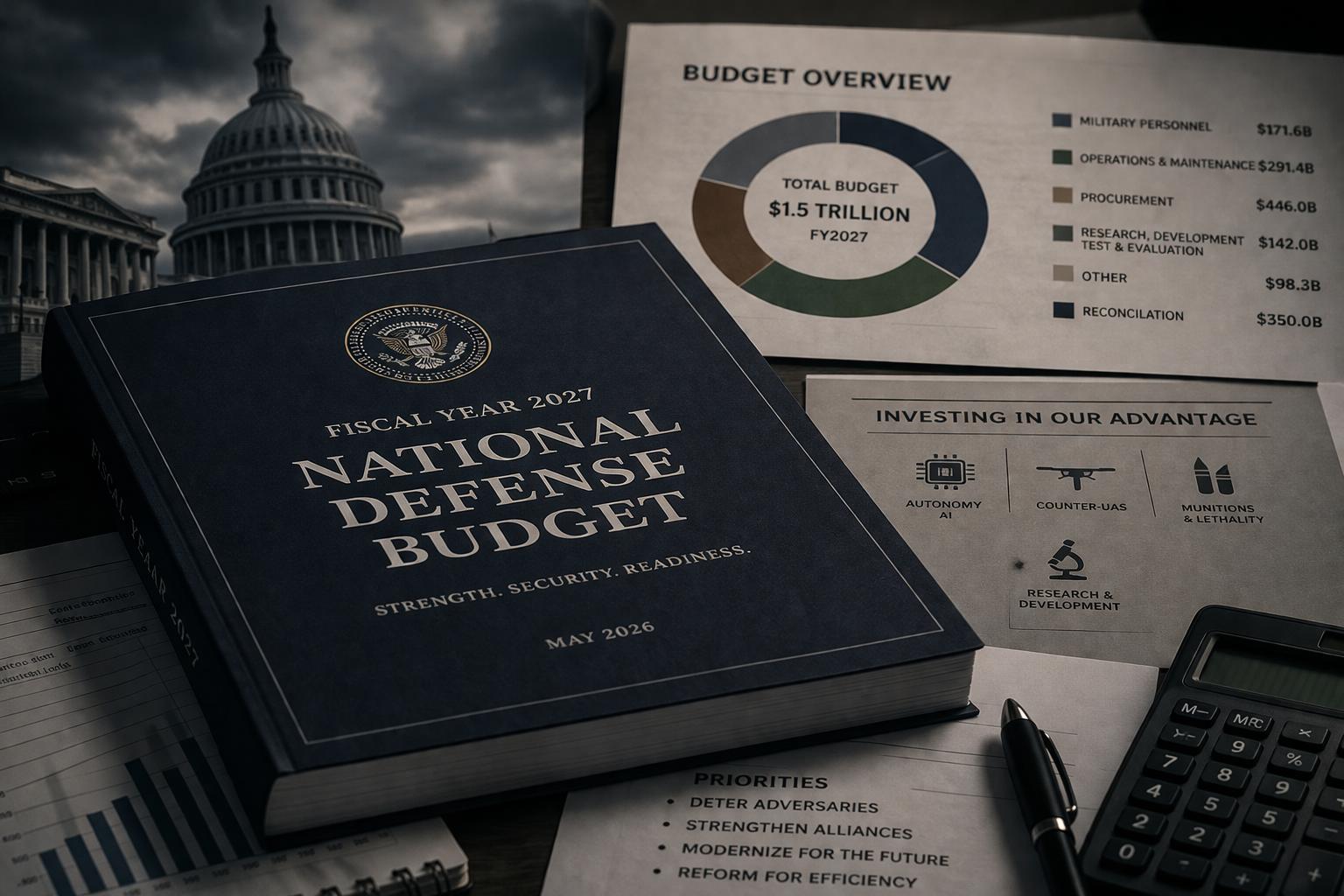
The Department of War (DoW) recently announced its FY2027 budget, featuring headline-grabbing figures: a total of $1.5 trillion, representing a $445 billion increase from the previous year. While this surge in funding is drawing strong interest across the defense technology ecosystem, there are several key dynamics we are actively assessing—and will continue to monitor—as we position to take advantage of increased investment areas. In particular, significant funding is being directed toward counter-unmanned aerial systems (cUAS), a mission set where ZeroMark’s technology has demonstrated strong alignment.
What is the National Defense Budget?
The FY2027 DoW budget is a forward-looking plan outlining how much the U.S. military expects to spend in fiscal year 2027 and over the following 2–5 years. At its core, the budget signals intent and priorities across the defense sector, spanning everything from ships and satellites to personnel growth and emerging technologies. While this represents a significant increase in funding with the potential to drive major innovation, the proposed budget must still be approved by Congress. For a small defense technology firm, understanding how this $1.5T flows from proposal to execution is critical to positioning for access. In this section, we examine how ZeroMark analyzes the defense budget to forecast business development opportunities.
The budget is divided into two primary funding categories: reconciliation and the base budget. Reconciliation represents a one-time, lump-sum allocation placed in defense-wide accounts. It typically provides less detail upfront and requires only a simple majority in both chambers of Congress to pass. Given current Republican majorities in the House and Senate, this pathway may present fewer procedural barriers for the administration. In contrast, the base budget follows the traditional appropriations process, requiring broader bipartisan support—particularly in the Senate, where 60 votes are needed. This portion of the budget is highly detailed, program-specific, and subject to strong congressional oversight.
Overall, this proposal represents the largest defense funding level in a single fiscal year since World War II. The base budget, totaling approximately $1.15T, includes funding for military personnel, operations and maintenance, procurement, and research and development (R&D). The remaining $350B is allocated through reconciliation, with a notable emphasis on artificial intelligence and cUAS.
How likely is the budget to pass? The outlook remains uncertain. The base budget could face delays due to opposition from the Democratic Party and the need for bipartisan agreement. Reconciliation, while procedurally simpler, is not without challenges, as internal divisions within the Republican Party—particularly given its narrow House majority—may complicate negotiations over spending priorities. Additionally, the upcoming midterm elections introduce further uncertainty, which could delay passage or significantly alter the final topline figure.
ZeroMark Assessment
As noted, more detail is still forthcoming on how these funds will ultimately be allocated, but we are already identifying clear increases in funding for counter-unmanned aerial systems (cUAS), AI adoption, research and development, and soldier lethality—areas that strongly align with ZeroMark’s technology. A significant portion of reconciliation funding is directed toward R&D and procurement, with substantial investments in munitions to replenish stockpiles following the war in Iran.
Across the services, cUAS stands out as a primary growth area, with each branch making meaningful investments in layered, interoperable defense capabilities. The Air Force is requesting $1.4B for Air Base Air Defense (ABAD), including $89M specifically for counter-small UAS (c-sUAS), signaling a push toward integrated base defense systems capable of addressing modern aerial threats. The Army is making even larger investments—approaching $1B in FY2027 alone and up to $1.9B across related efforts—in expeditionary and mobile c-sUAS platforms that span fixed, mounted, and dismounted configurations. These systems emphasize a mix of kinetic and non-kinetic capabilities, supported by sensors, electronic warfare, electro-optical/infrared technologies, and interoperable fire control systems ranging from soldier-common to unit common solutions. Across the services, cUAS stands out as a primary growth area, with each branch making meaningful investments in layered, interoperable defense capabilities.
Taken together, these investments reflect a broader shift toward software-enabled, networked defense systems that connect detection, decision-making, and effectors across domains. This aligns closely with ZeroMark’s strengths in targeting, autonomy, and system integration, particularly as the Department of War prioritizes scalable, rapidly deployable solutions capable of operating in joint and contested environments.
Another important dynamic is that many of these funding increases will not need to be executed within a single year. While reconciliation funding typically carries a two-year execution window, FY2027 RDT&E funds can be obligated over a five-year period. This extended runway reduces the risk of overwhelming the industry with immediate demand and gives companies more time to adjust manufacturing capacity, hiring, and supply chain planning. It also creates a structural incentive for industry to invest in the capabilities the Department is seeking.
However, this extended timeline should not be mistaken for an opportunity to wait. It is a narrow and highly strategic window to act. The companies that move now will help shape requirements, influence program direction, and establish themselves as the default solution set before funding is fully locked in. Early investments, particularly in areas like live-fire demonstrations alongside operators, can generate outsized returns by accelerating validation, building internal advocacy, and embedding capabilities ahead of formal program definition.
By contrast, a wait-and-see approach carries significant opportunity cost. Once funding decisions are finalized, the competitive landscape is largely set. Vendors that engage early are already aligned to requirements, integrated into workflows, and positioned for contract capture. Late entrants are forced to compete uphill against incumbency and established momentum.
For investors, this moment is less about optionality and more about timing advantage. The extended funding runway does not reduce urgency; it amplifies the value of early capital deployment. This is the phase where targeted investment can directly translate into program influence, accelerated adoption, and a disproportionate share of downstream contract value.
Positioning for Future Growth
As we wait for additional clarity on how FY2027 funds will ultimately be allocated, we recognize that much of this capital, particularly within flexible accounts like RDT&E, remains unassigned. Rather than waiting for requirements to be formalized, ZeroMark is proactively positioning alongside the customers and mission sets most likely to receive and deploy these funds. In parallel, we are tracking emerging programs, such as the Navy’s MK 38 upgrade, engaging early with stakeholders and aligning our technology against anticipated requirements before they are formally publicized. By the time needs are codified, we are not reacting to them; we are already demonstrating how we meet them.
Our approach is deliberate and repeatable. We build high-conviction relationships with operational units, program offices, and innovation organizations by consistently demonstrating a deep understanding of their missions, constraints, and evolving requirements. This requires honesty about where our capabilities excel, where they don’t, and a commitment to the customer’s success as the primary measure of our performance. Over time, this positions ZeroMark as a low-risk, high-confidence partner when organizations begin prioritizing funding.
We have conducted hundreds of live-fire demonstrations and operational engagements, and one insight consistently holds: adoption accelerates when operators are able to use the system themselves. These engagements create demand from the bottom up by validating performance in conditions that simulate the battlefield. In multiple cases, that demand has translated directly into procurement activity. For example, a December 2025 engagement with New Jersey military and law enforcement on drone threats to critical infrastructure led to a formal RFI and a demonstration of our APEX technology with a base security unit aligned to our target market. That unit is now positioned to procure using funds specifically allocated to address cUAS gaps.
Demonstrations, whether government-sponsored or ZeroMark-led, expand visibility across units and commands while converting interest into advocacy. These efforts have provided access to high-value venues such as iSOF, Dillon Aero’s Manifest West, OUSD’s T-REX, and the Army’s Operation Flytrap and xTech programs. Some engagements have produced immediate outcomes, including the Global Tactical Edge Acquisition Directorate (G-TEAD) Master Business Agreement, which establishes a contracting pathway for sales to U.S. military, federal, and NATO partners. Other engagements have reinforced relationships and built internal momentum, so when funding becomes available, procurement decisions are already supported.
In environments where direct engagement is more limited, we leverage RDT&E pathways such as SBIRs and CRADAs to gain earlier access in the requirements cycle. These mechanisms allow us to align with funded priorities like cUAS, AI, and soldier lethality while generating non-dilutive capital to further develop our system. They also provide critical insight into how requirements are evolving, ensuring that our engineering efforts are tied to real, funded needs rather than theoretical ones.
As a small company, we extend our reach through targeted partnerships with established defense manufacturers such as Dillon Aero and Mossberg. These partnerships enable integration into existing weapons ecosystems and open procurement pathways that would otherwise be difficult to access. They also enhance credibility, improve interoperability, and position our technology within platforms that are already trusted and widely fielded.
Across all of these efforts, repeatability is a key driver. Our demonstrations, integrations, and deployments are designed to be simple, consistent, and easy for units to adopt without requiring changes to existing tactics, techniques, and procedures. This reduces friction during evaluation, accelerates decision-making, and increases the likelihood that systems can move efficiently from demonstration to requirement, from requirement to funding, and ultimately into the hands of operators.
At its core, our strategy is built around a simple principle: be present before the money moves. By aligning early with the organizations most likely to receive funding, building trust through repeated engagement, and creating demand at the operator level, ZeroMark ensures that when budgets transition into executable programs, we are already part of the solution set.

